Live Casino vs RNG Casino: Which Experience Is Really Different?
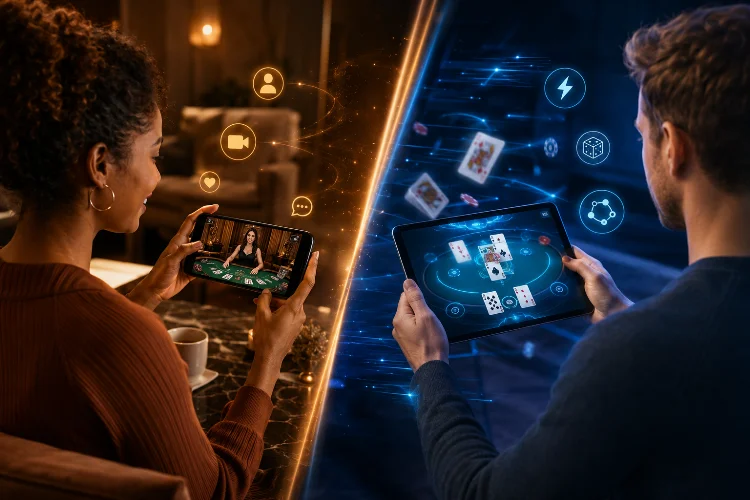
Imagine opening two blackjack games on the same phone.
The first shows a real dealer sitting behind a table, physically dealing cards while a video stream runs above your betting controls. The second uses animated cards and completes rounds almost instantly without another person appearing on screen.
Both are online blackjack, but the technology behind them is very different.
The Live Casino vs RNG Casino comparison is essentially a choice between a physical game delivered digitally and a game created almost entirely through software. That difference affects speed, interaction, technical requirements, scalability, and how randomness is produced.
Understanding those distinctions is useful because the graphics alone can sometimes make the two formats seem more similar than they really are.
Live Casino Connects a Physical Table to Digital Players
A live casino studio is essentially a bridge between physical and online gaming.
Dealers work at real tables while cameras broadcast the action to remote users.
The player’s bets still happen digitally.
You tap a chip or button on your device, the gaming system records the wager, and the studio continues the physical game.
Evolution operates live dealer environments serving games such as blackjack, roulette, and baccarat, including studios designed to broadcast to online players.
This explains why live casino feels different from a normal video game.
The computer is not creating every visible element.
It is showing an event happening somewhere else.
RNG Games Create the Result Through Software
RNG casino games take another approach.
The outcome is generated digitally using a Random Number Generator and the mathematical rules of the game.
The Gambling Commission defines an RNG as hardware or software intended to produce random numbers with statistical randomness.
The random number is then converted into an appropriate game result.
In a slot, that can mean determining which symbols appear.
In digital roulette, it can identify the winning number before the animation presents the result.
In software-based card games, randomisation determines which cards are produced according to the game’s rules.
The important point is that the animation does not physically create the randomness.
It displays the output of the underlying game system.
Random Does Not Mean Unregulated
Some players feel more comfortable seeing a physical roulette wheel because they can watch the ball moving.
Software randomness can feel less visible.
That does not mean regulated RNG products simply generate whatever result an operator wants.
For games within its jurisdiction, the UK Gambling Commission requires random outcomes to be acceptably random and statistically testable. Adaptive or compensated behaviour is not permitted under its random-outcome requirement.
Testing is also part of the framework.
Relevant licence holders must submit game and RNG test results to the Gambling Commission.
That is why regulatory status is more meaningful than trying to judge fairness from graphics.
A realistic wheel animation tells you very little about the quality of the underlying operator.
Live Dealer Fairness Uses Different Controls
Live games cannot rely only on RNG testing because the result may be created by physical cards, wheels, or other equipment.
Instead, regulators focus on operational procedures.
The Gambling Commission’s live dealer standards require operations to be fair and independently auditable. They include controls covering croupier training, supervision, surveillance, gaming equipment, access controls, and records.
This means the two formats reach the same broad goal through different methods.
RNG casino testing asks whether software randomness and game mathematics operate correctly.
Live casino auditing also asks whether physical equipment and studio procedures are being handled properly.
Neither should simply be trusted because it looks professional.
RNG Games Normally Give Players More Control Over Pace
A software-generated game does not have to wait for anyone else.
If you finish a blackjack round, you can often begin another immediately.
Live games have a shared physical timeline.
The dealer needs to deal cards, announce actions, collect or prepare equipment, and move into the next round.
Betting windows also have deadlines.
For players who enjoy a relaxed table atmosphere, this slower pace may feel more natural.
For someone who prefers quick gameplay, RNG versions may feel smoother.
The difference becomes especially noticeable on mobile, where users often play in shorter sessions.
Latency Creates an Extra Challenge for Live Games
RNG casino games still require an internet connection when played through an online operator, but they usually do not depend on constant real-time video.
Live casino does.
The studio captures the video, the stream travels through networks, the player’s device displays it, and player commands travel back to the gaming system.
Every step can introduce small delays.
The UK Gambling Commission explicitly recognises network speed and end-user device performance as potential disadvantages in time-sensitive gambling events.
That is why a live roulette game may stop accepting wagers before a delayed video feed makes it appear absolutely necessary.
The server-side betting state matters more than what a slightly delayed screen appears to show.
Live Casino Offers Human Interaction
One area where RNG software cannot completely reproduce the experience is direct human presence.
A dealer can greet players, speak naturally, react to the table, and create the feeling of a shared session.
That gives live casino a social layer.
Even players who never type into chat can still feel as though someone is hosting the game.
RNG products normally replace that social interaction with animation, sound effects, and interface design.
This can be more private and focused.
Some players prefer not having another person involved at all.
Once again, the difference is preference rather than quality.
RNG Games Give Designers More Creative Freedom
A physical table comes with limitations.
A roulette wheel has a specific structure. Playing cards follow recognisable rules. A dealer can only perform so many actions during one round.
Software does not face the same constraints.
An RNG game can use elaborate animation, unusual reel grids, fantasy environments, bonus mechanics, transformations, or mathematical structures that would be difficult to reproduce with physical equipment.
That is one reason slots are overwhelmingly suited to RNG-style digital production.
Live casino providers have responded by adding digital overlays and entertainment-style formats, but the physical studio remains part of the experience.
RNG gaming begins with software, so developers have more freedom from the start.
What Happens When a Connection Is Interrupted?
A disconnection can affect both formats, although the experience may be more noticeable during live play.
If a live game continues at the studio while your video freezes, the physical round does not necessarily stop.
Game systems therefore need procedures for determining whether a wager was successfully accepted and how its result should be handled.
The broader principle under UK remote gambling rules is that result determination should follow the published operator and game rules.
RNG games can also experience network interruptions, but they generally have fewer streaming components involved.
The key information is the confirmed game state held by the operator’s system rather than whether the animation finished correctly on the player’s screen.
Are Live Games More Real Than RNG Games?
They are more physically tangible, but “more real” can be misleading.
A live roulette wheel genuinely exists in a studio.
An RNG roulette wheel may exist only as software.
Yet both are still online gambling products accessed through a digital platform.
The live version relies on technology for betting, streaming, accounts, and settlement.
The RNG version relies on software for both presentation and outcome generation.
So the more useful question is not which one is real.
It is which type of experience someone prefers: physical action streamed online or software-generated gameplay.
Which Is Easier for Beginners?
Live games can be useful when someone wants to see how a traditional table game physically operates.
Watching a dealer handle blackjack cards can make the flow easier to understand.
RNG games may be easier when the priority is learning at a personal pace without waiting for other participants.
Either way, the game rules matter more than the delivery technology.
Understanding blackjack does not automatically make roulette understandable, and switching from RNG blackjack to live blackjack does not remove the underlying probability or house advantage.
Beginners should start with the rules and limits rather than looking for a format that supposedly produces better outcomes.
The Live Casino vs RNG Casino comparison is ultimately about two different ways of delivering online casino games.
Live casino combines physical dealers and equipment with cameras, streaming, and digital betting technology. RNG games generate results through tested software and then present those outcomes through digital graphics.
Live gaming offers human interaction and a physical-table atmosphere, while RNG games are usually faster and give developers more flexibility.
Neither format can guarantee better results. The game’s mathematics, rules, and regulatory framework remain important regardless of presentation.
If you choose to participate where online gambling is legal, check the operator’s licensing status, understand the game before betting, and use spending and time limits that keep the activity within entertainment.