How Live Casino Games Work Behind the Scenes
Watching live roulette or blackjack on a phone can feel surprisingly similar to looking through a window into a real casino. A dealer handles physical cards or spins an actual roulette wheel while players place bets through buttons on their screens.
But there is much more happening behind that video feed.
Understanding how Live Casino Games Work means looking at the combination of physical casino equipment, trained presenters, cameras, audio systems, betting software, servers, and real-time communication technology.
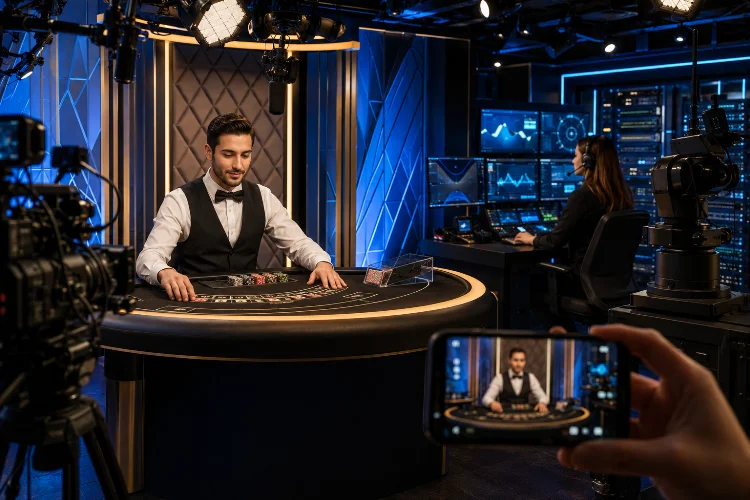
Major providers operate purpose-built studios that resemble television production facilities as much as traditional casino floors. Evolution describes its studios as advanced TV or film-style environments using multi-camera, audio, and IT technology to broadcast games in real time.
Here is what happens from the studio table to the screen in front of you.
1. Live Casino Games Start in a Real Studio
Unlike traditional digital casino games that can exist entirely inside software, live dealer games usually begin with a physical table.
There may be a roulette wheel, blackjack table, baccarat shoe, cards, chips, dice, lighting equipment, and one or more cameras surrounding the game.
Playtech operates dedicated live studios in Europe, the United States, and Latin America, while Evolution runs live tables and game-show environments across multiple regions.
The environment is deliberately controlled.
Lighting needs to make cards and table markings clearly visible, cameras need unobstructed views, and background noise has to be managed so players can hear the dealer.
Playtech has described one of its US facilities as being closer to a television studio when viewed behind the cameras, complete with lighting, monitors, microphones, and production equipment.
2. Professional Dealers Run the Physical Game
The person you see on screen is not simply a video host.
Dealers or croupiers are responsible for physically conducting the game according to established procedures. Depending on the title, that may involve dealing cards, spinning a roulette wheel, managing baccarat rounds, or presenting game-show-style formats.
Evolution says new live dealers receive training covering game knowledge, presentation, communication, and running online tables efficiently.
Regulation can also set expectations around dealer competence.
The UK Gambling Commission requires live dealer operations within its jurisdiction to be fair and independently auditable. Its technical standards state that croupiers should receive adequate training and that records of training and refresher training should be maintained.
So although the experience looks relaxed on camera, there are documented procedures behind each round.
3. Multiple Cameras Turn the Table Into a Live Broadcast
A live casino table normally uses more than one camera angle.
One camera may show the dealer, while another focuses on the cards or roulette wheel. Premium versions can use several cameras to create close-ups, slow-motion views, or alternative perspectives.
Evolution’s Immersive Roulette, for example, uses multiple cameras around the table and wheel to provide closer views of the physical action.
This is where live casino starts looking much more like television production.
The video feed is captured inside the studio, processed, and streamed through the provider’s technology to participating casino platforms. Players then receive that stream through a browser or compatible mobile interface.
The visual stream is only one layer, however.
The betting interface displayed around it is software.
4. Your Bets Travel Through a Digital Interface
When you tap £5 on red in roulette or choose “Hit” during blackjack, you are not physically passing chips to the dealer.
Your action is transmitted digitally.
The live casino interface displays available wagers, your balance, betting timers, game decisions, and eventually the result. Evolution describes its software as allowing players to place wagers, make decisions, and communicate with dealers through the interface surrounding the live stream.
That creates two connected experiences.
The physical layer is the dealer, cards, wheel, or other casino equipment.
The digital layer records the player’s actions and processes the financial side of participation.
Both have to remain synchronised so that the player’s wager belongs to the correct physical game round.
5. Betting Windows Keep Everyone on the Same Round
Live games happen continuously, so players need a clearly defined period in which they can join each round.
Roulette provides an easy example.
The interface opens betting while the dealer prepares or spins the wheel. At a predetermined point, wagering closes. Any attempt to place a new wager after that cutoff should not simply be added after the outcome is already known.
Timing is particularly important because online players can have different internet speeds.
The UK Gambling Commission’s technical standards specifically address time-critical events. Operators must consider whether network latency or device performance could unfairly disadvantage players and take reasonable steps to reduce that risk.
This is one reason a live casino interface may disable betting slightly before the physical result appears on screen.
6. The Game System Connects the Physical Result to Digital Bets
Once the physical outcome is known, the online system needs to settle all eligible bets according to the game’s rules.
In roulette, that means matching the winning number against each player’s accepted wagers.
In blackjack, it means evaluating hands according to the rules of the particular table.
This process is controlled by casino software and operational procedures rather than by the video stream alone.
The UK Gambling Commission’s result-determination standard requires gambling systems to accept, process, and settle wagers according to the published operator and game rules.
That principle is crucial.
The dealer produces or reveals the physical result, while the supporting system connects that result with thousands of remote player transactions.
7. Surveillance Continues Behind the Player-Facing Cameras
The camera you watch is not necessarily the only camera monitoring the table.
Regulated studios can also use surveillance specifically for game integrity.
UK Gambling Commission standards state that live dealer operations should have video surveillance covering dealer activity in enough detail to determine whether procedures and game rules were followed. They also call for supervision, equipment monitoring, access controls, and game logs.
This creates an audit trail.
If something unusual happens at a table, operators may have records that can help reconstruct the event rather than relying only on what an individual player remembers seeing.
The standards also state that live studio equipment and consumables should be of commercial casino quality.
8. One Studio Can Serve Players Across Many Devices
The dealer does not need separate physical tables for every type of screen.
A single live feed can be delivered through compatible desktop, tablet, and mobile interfaces.
Evolution states that its live games are streamed to phones, tablets, and computers, while its supporting software adapts the interaction around the broadcast.
Playtech similarly operates studios intended to provide live gaming across regulated digital environments and highlights investment in low-latency streaming technology.
That scalability is one of the major differences between live online gaming and a physical casino.
A land-based blackjack table might accommodate only a handful of seated players. Certain online formats can support a much larger remote audience around the same live presentation.
9. Fairness Depends on More Than Having a Real Dealer
Seeing a human dealer does not automatically prove that a gambling service is trustworthy.
Regulation, operational controls, secure systems, supervision, training, transaction processing, and auditability also matter.
The UK Gambling Commission’s current remote technical framework includes requirements covering game rules, result determination, time-critical events, security, and live dealer studios. Its remote standards were updated in January 2026, with further changes effective from June 30, 2026.
For players, the practical takeaway is straightforward.
When real money is involved, check whether the operator is legally available and appropriately licensed in your jurisdiction rather than judging credibility from studio graphics alone.
Once you look behind the video feed, understanding how Live Casino Games Work becomes much easier.
A professional studio provides the physical environment. Dealers conduct the game, cameras and microphones broadcast the action, and digital systems handle player bets, decisions, account balances, and settlement. Timing technology keeps remote players connected to the correct round, while surveillance and operational controls support fairness and auditing.
It is essentially a combination of casino operations, television production, and real-time web technology.
If you explore live dealer games, start by understanding the table rules and checking the operator’s regulatory status. The polished video is entertaining, but the systems behind it are what make the experience function.