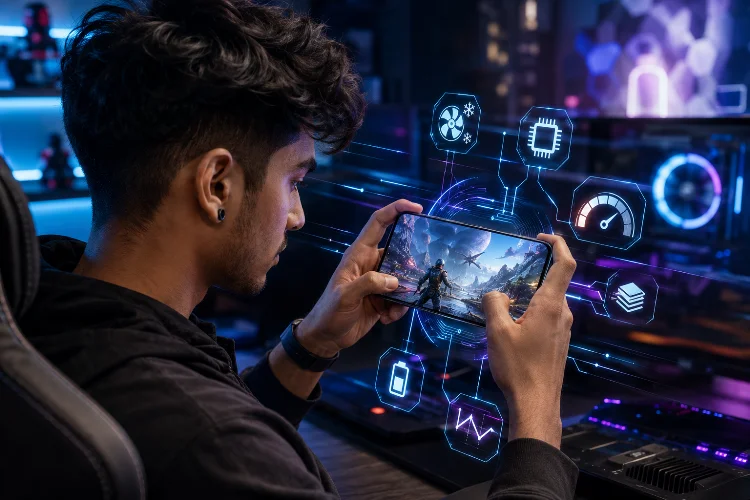
Mobile Gaming Technology Every Player Should Understand
A modern smartphone can do far more than run simple puzzle games. Today’s devices can handle detailed 3D worlds, competitive shooters, racing games, large RPGs, and multiplayer experiences that would have been difficult to imagine on phones a decade ago.
Behind that progress is increasingly sophisticated Mobile Gaming Technology. Powerful processors, dedicated graphics hardware, high-refresh-rate displays, advanced graphics APIs, and smarter power management all work together to make games look better and feel smoother.
Players do not need to become hardware engineers to understand these features. However, knowing what terms such as GPU, FPS, Vulkan, refresh rate, and thermal management actually mean can make choosing a gaming phone—and adjusting game settings—much easier.
1. The Processor Is the Heart of the Experience
A smartphone’s system-on-chip, commonly called the SoC, combines important components such as the CPU and GPU.
The CPU handles calculations, game logic, background processes, physics, and other general tasks. The GPU focuses heavily on drawing graphics, effects, environments, and animations.
Modern mobile processors have become remarkably capable. Qualcomm’s Snapdragon gaming platforms, for example, combine high-performance CPUs with Adreno graphics and gaming-focused software features designed to balance graphics performance and efficiency.
For players, a stronger processor generally means better potential performance—but optimization matters just as much as raw specifications.
2. GPUs Are Responsible for Those Better Graphics
When a game displays detailed shadows, reflections, complex environments, and hundreds of objects, the GPU does much of the heavy lifting.
Mobile GPUs have evolved to support technologies once associated mainly with PCs and consoles. Qualcomm’s current gaming technology includes features such as hardware-accelerated ray tracing and more efficient geometry processing on supported hardware.
Apple uses its own GPU architecture alongside Metal, its graphics framework that gives developers low-overhead access to graphics hardware across devices including iPhone and iPad.
Better graphics hardware does not simply make games prettier. It can also help maintain smoother performance at higher resolutions.
3. Refresh Rate and FPS Are Not the Same Thing
You have probably seen phones advertised with 90Hz, 120Hz, or even higher-refresh-rate screens.
Refresh rate describes how many times the display can update each second. FPS, or frames per second, describes how many frames the game actually produces.
A 120Hz screen does not automatically mean a game runs at 120 FPS.
Android’s gaming documentation notes that modern devices increasingly support displays such as 90Hz and 120Hz, but developers still need to manage frame rates carefully because constantly targeting higher FPS can increase power consumption.
For many players, stable 60 FPS can feel better than an unstable frame rate constantly jumping between higher and lower values.
4. Frame Pacing Makes Games Feel Smoother
Average FPS is important, but consistency matters too.
Imagine a game averaging 60 FPS while occasionally freezing for a fraction of a second. The number sounds impressive, yet the experience can still feel rough.
That is where frame pacing matters.
Google explains that correct frame pacing helps frames appear at regular intervals, reducing noticeable stutter and input latency. Its Android Frame Pacing library can also match presentation more appropriately to supported display refresh rates.
This is why two phones producing similar average FPS numbers can sometimes feel surprisingly different during actual gameplay.
5. Vulkan and Metal Power Modern Graphics
Graphics APIs act as a bridge between games and graphics hardware.
On Android, Vulkan provides developers with low-level access to modern GPU capabilities. Google describes Vulkan as a way to achieve higher-performance graphics and notes that major engines such as Unity and Unreal use it on compatible Android devices.
On Apple devices, Metal performs a similar role by giving developers direct access to Apple-designed GPUs. Apple also provides technologies such as MetalFX that can improve performance by rendering at a lower resolution and intelligently upscaling the result.
Players may never interact with these technologies directly, but they influence what developers can achieve.
6. Battery Efficiency Matters as Much as Speed
Running demanding games creates heat and consumes power.
A phone capable of extremely high performance for five minutes is less useful if heat forces it to slow dramatically during a longer session. This behaviour is one reason sustained performance matters when evaluating gaming devices.
Android’s game-development guidance recommends matching display refresh rates closely with a game’s actual target frame rate because unnecessary display updates consume additional power without improving the experience.
Qualcomm likewise focuses on balancing GPU performance with power efficiency in its mobile gaming technologies.
For players, lowering graphics quality or FPS slightly can sometimes produce a smoother long-term session while extending battery life.
Understanding Mobile Gaming Technology makes it easier to separate useful gaming features from impressive-looking specifications. The CPU and GPU determine much of a phone’s performance potential, while refresh rates, stable frame pacing, graphics APIs, and power management influence how that performance actually feels during gameplay.
You do not always need the fastest phone or the highest graphics settings. A balanced device that maintains stable performance can provide a better experience than one chasing maximum benchmark numbers.
Next time you compare gaming phones or change in-game settings, look beyond raw specifications and pay attention to FPS stability, efficiency, graphics support, and sustained performance.